

About FaMiPA

FaMiPA stands for Fachstelle Migration, Pflege und Alter. The aim of the specialist unit is to make the needs and concerns of senior citizens with a history of migration in Berlin visible, to structurally reduce discrimination and to promote their equal participation.
Our team

Amrit Walia
(she/he)
Referent
Hanna Kerkhof
(she/he)
Coordinator
Simone Koschewa
(she/he)
Referent
Our partners in Berlin

Briefly state the purpose of the cooperation. Why? Networking is a work assignment and creates trust.
Frequently asked questions
On this page you will find frequently asked questions about the work of FaMiPA.
Does FaMiPA provide advice?
No, FaMiPA does not provide advice. We do not provide advice on care services, care levels and your entitlements. However, we do provide referral advice. This means that we will refer you to other suitable contact points in Berlin. You can find a list of contact points and information on our website.
Even though we are not a traditional advice center, we are always ready to listen to you. If you have any questions about FaMiPA’s work, please contact us at famipa@awoberlin.de or call us on +49 30 / 25 389 287. You can usually reach us from Monday to Friday between 10 am and 4 pm.
I am a senior citizen with a history of migration and would like to initiate a project. Can I register with FaMiPA for this?
Yes, with pleasure! Let us know your idea of the project and we will look together at the possibilities for implementation. Feel free to contact us at famipa@awoberlin.de or call us on +49 30 / 25 389 287. You can usually reach us from Monday to Friday between 10 am and 4 pm.
Do the FaMiPA offers and events cost anything?
No, FaMiPA offers and events are free of charge.
How is FaMiPA financed?
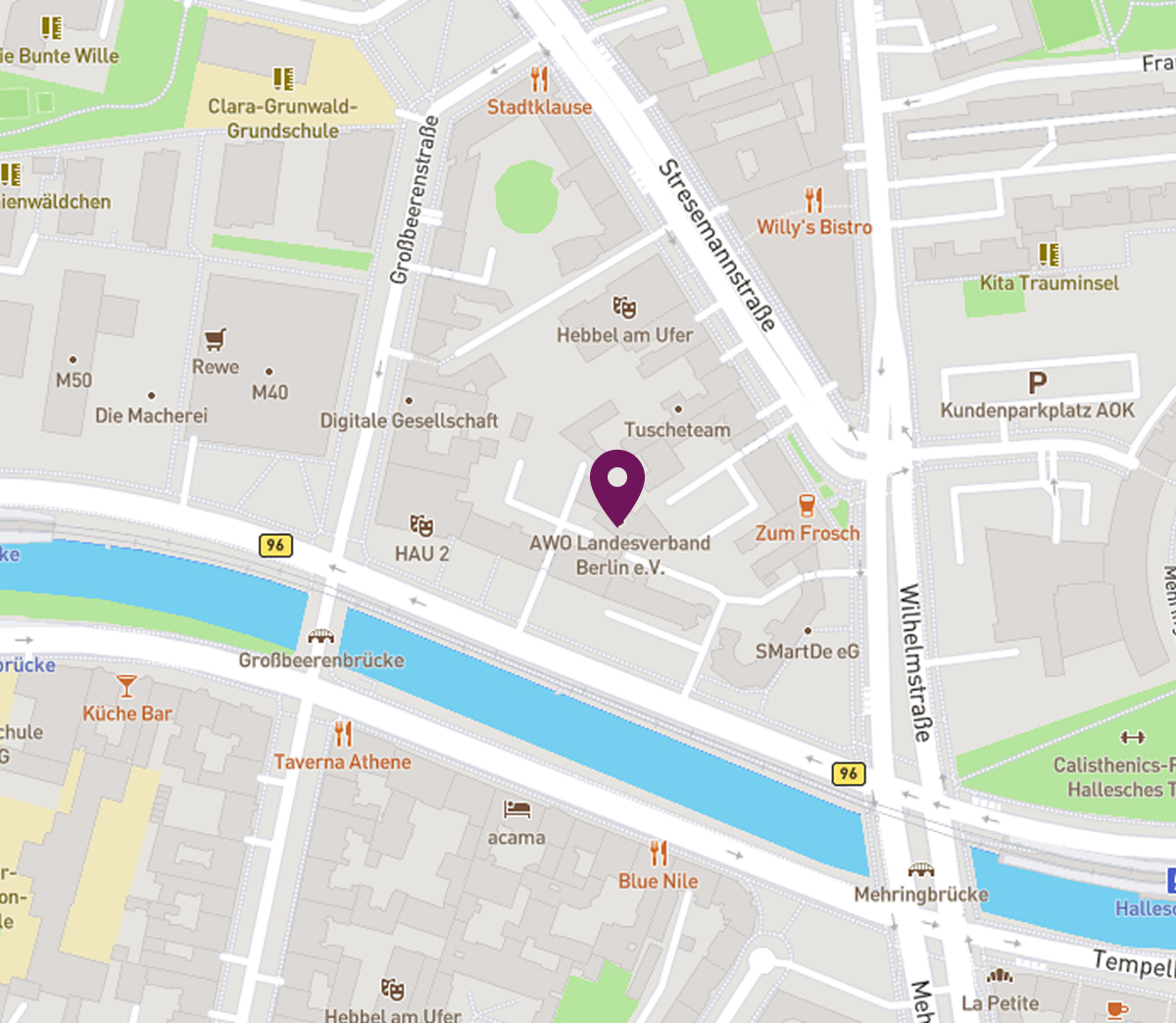
FaMiPA has been funded by the Senate Department for Science, Health and Care since 2025. The specialist center is a project of the AWO Landesverband Berlin e.V. and works throughout Berlin and across associations.
How long has FaMiPA been around and who works there?
FaMiPA has been in existence since summer 2025 and the three of us work together: Amrit Walia and Simone Koschewa are the advisors at the specialist unit. Hanna Kerkhof coordinates the specialist unit.
I would like to network professionally with FaMiPA as I work in this field. How do I do that?
We look forward to networking with you. Only with a strong network can we ensure that senior citizens with a history of migration are well looked after in Berlin. Feel free to contact us at famipa@awoberlin.de or call us on +49 30 / 25 389 287. You can usually reach us from Monday to Friday between 10 am and 4 pm.
I am organizing an offer or an event for senior citizens with a history of migration in Berlin in the context of care and ageing. Can this offer be advertised on FaMiPa's website?
Yes, that is possible. It is important that your offer/event is in the context of migration, care and old age. In addition, it must not be a profit-oriented or commercial offer. We look forward to hearing more about your offer or event.
Please contact us at famipa@awoberlin.de or call us on +49 30 / 25 389 287. You can usually reach us from Monday to Friday between 10 am and 4 pm.
Glossary
Critical of discrimination
Being critical of discrimination implies the awareness and consideration that discrimination is omnipresent in our society. This attitude implies the knowledge that all people are socially positioned on the basis of different forms of discrimination.
[Source: Information and Documentation Center for Antiracism Work (IDA) (n.d.)]
Intersectionality
Intersectionality means taking into account and being aware of the fact that different forms of discrimination – e.g. based on gender, origin, age, class or residence status – do not act separately from each other, but rather reinforce each other.
[Source: Crenshaw 1989]
Further sources:
Dr. Emilia Roig explains intersectionality (Friedrich Ebert Foundation):
https://www.youtube.com/watch?v=hOa4MuPQbMM
History of intersectionality explained simply:
https://youtu.be/EP4gOj4TTiQ?si=rrIRD9eZjYxS62Va
Participation
Participation means (political) involvement. Participation means joining in and having a say.
Need for care
If you notice that you can no longer do things on your own (e.g. washing, shopping or eating), you may be in need of care.
The Medical Service will check whether you are in need of care. You must submit an application to your care insurance fund for this assessment. You can find more information on this under Degree of care.
Degree of care
To be able to apply for care services, you must have a care degree. You can apply for a care degree by submitting an application for a care degree. You submit this application to your care insurance fund: Statutory health insurance: Your care insurance fund is the same as your health insurance fund. You submit the application there. Private insurance: Your private compulsory long-term care insurance (PPV). You submit the application there. If you need support with the application, the Intercultural Bridge Builders in Care and the Berlin Care Support Centers will help you.
Contact us
We listen
You can reach us from Monday – Friday 10 am – 4 pm
Telephone